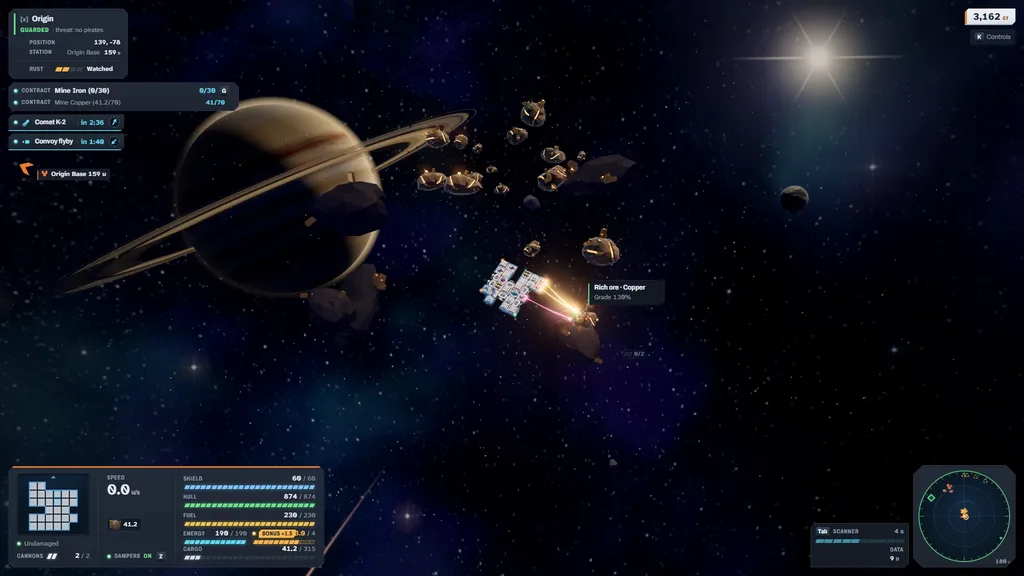
Automated tests are good at finding what is broken. Whether a game is enjoyable, readable or fair is still something only a person playing it can say.
What a robot pilot can catch
The pilot is an ordinary script, not a language-model agent, and it plays the game through the same simulation interface a player's ship would use. Run across many random seeds, it reports how long each milestone takes and how money flows. Because the author runs a quick version with every change, a tweak that suddenly makes progress much faster or slower shows up as a number. The notes say the pilot can show that a milestone arrives within a few percent of the previous build. 1
Your newsroom, run by agents. You set the mission.
The second mode, which the notes call the saboteur, hunts for arbitrage loops, softlocks (states where a player can no longer progress) and ways to get paid twice. After the game's Guild and trade milestone, it produced a list of exploits, and the notes say all were fixed before that pass closed. The notes do not say how many there were. 1
Performance is the clearest measured win. Before a follow-up pass, opening the map with a route planned cost about 24 milliseconds of JavaScript per frame on a throttled processor, and the station screen about 15. Afterward the notes give roughly 2 and 6. 1
What it cannot
The same notes draw the line plainly: the bot can say a milestone arrived on schedule, but it "cannot say the milestone is enjoyable." Whether the economy feels fair, rather than balanced on paper, is listed as a question for a human. So the author plays each build and feeds what they find back into the next round of design. The notes call this playtesting non-optional. 1
The notes give no session counts or specific complaints from playtests, so we cannot say what the author's play sessions caught that the suite missed. What they do establish is the division of labor: numbers for the economy, a person for the feel.
Making a game is getting cheaper; knowing if it works is not
In July 2026 Roblox announced Build, a tool in its mobile app that turns a text prompt into a basic game a creator can then refine, playtest, share or publish. A public alpha of select features began July 28 for users in New Zealand, with wider rollout planned over the following months. 2
That lowers the cost of a first draft. It does not tell the creator whether anyone will want to play the draft twice. Roblox itself ranks published games by a retention-based discovery system, which is a measure of whether players come back. 2
Players are judging, too
A 2026 preprint analyzed 508,192 English-language Steam reviews and read a sample of 600 closely. Games that disclosed generative AI use had lower recommendation rates and more negative sentiment than games using procedural generation, which has been part of game design for decades. Reviewers often read AI use as a sign of low developer investment. 3
That is correlation. The games and their audiences may differ in other ways, and Steam reviewers are not all players. The authors' own conclusion is that generative AI works best when it serves players' needs rather than cutting costs. 3
After a build passes, then, the next test is a person at the controls. Where do they hesitate? Which choice do they care about? What do they want to try again? A bot can show where the game breaks. Only a player can say what it felt like.
References
- Cinderbelt: Made with AI development notes. (n.d.).
- Build Without Limits on Roblox. (n.d.). https://about.roblox.com/newsroom/2026/07/build-without-limits-on-roblox
- Player Perceptions of Generative AI in Games. (n.d.). https://arxiv.org/abs/2608.11539